Have you ever typed “curtesy” in an email or message only to have your spell checker flag it as incorrect? You’re not alone. Many English speakers wonder whether the correct spelling is curtesy or courtesy, especially since both words have appeared in dictionaries at different points in history.
If you’re searching for curtesy vs courtesy, the short answer is that courtesy is almost always the correct word in modern English. However, “curtesy” isn’t simply a typo—it has an interesting historical background that makes the comparison worth exploring.
In this guide, you’ll learn the difference between the two spellings, their meanings, origins, examples, and practical tips to ensure you always use the right one.
Curtesy vs Courtesy: Which Is Correct?
For nearly every modern writing situation, the correct spelling is:
Courtesy
The spelling curtesy is considered:
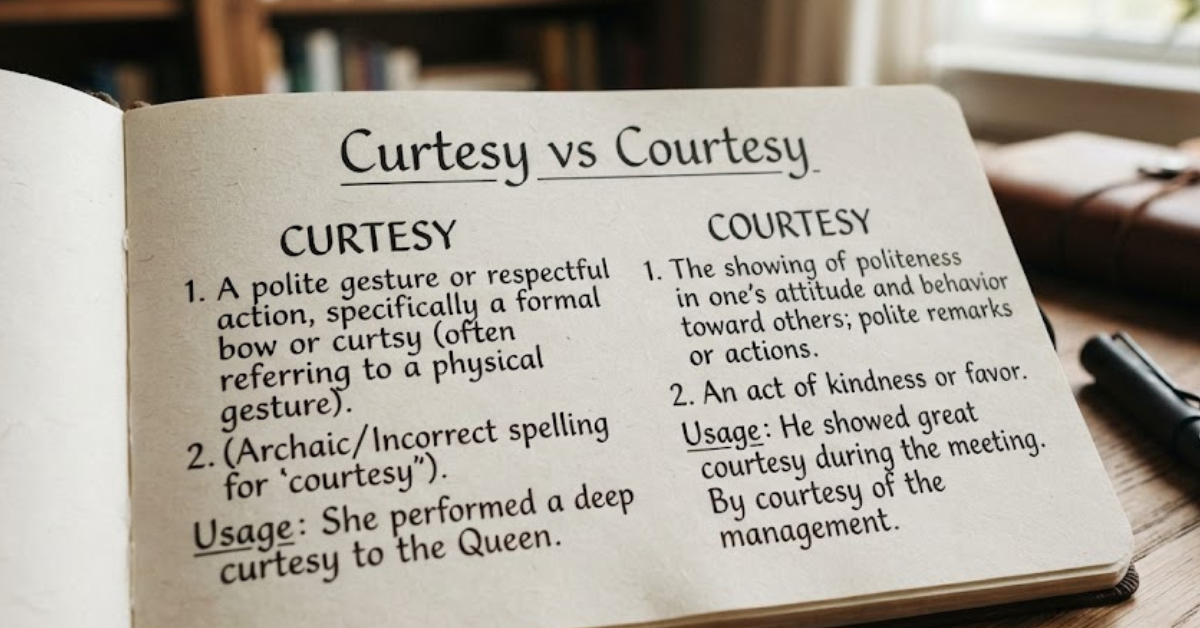
- An obsolete or archaic spelling of “courtesy”
- A historical legal term in specific contexts
- A common misspelling in modern English
If you’re writing an email, essay, business document, social media post, or text message, you should almost always choose courtesy.
What Does Courtesy Mean?
The word courtesy refers to:
- Polite behavior
- Respectful treatment of others
- Good manners
- Acts of kindness or consideration
It can also describe something provided free of charge as a favor or gesture of goodwill.
Examples include:
- Courtesy seating
- Courtesy call
- Courtesy copy
- Courtesy shuttle
- Courtesy reminder
The word is commonly used in both personal and professional communication.
Examples of Courtesy in Everyday English
Here are some common examples.
Politeness
- She thanked everyone as a matter of courtesy.
- Courtesy costs nothing but means a great deal.
- He showed courtesy toward every customer.
Free Service
- The hotel offered a courtesy shuttle.
- Guests received complimentary drinks as a courtesy.
- The company provided a courtesy replacement.
Professional Communication
- Please extend the courtesy of replying by Friday.
- Thank you for your courtesy and professionalism.
These examples show how versatile the word has become.
What Is Curtesy?
Although uncommon today, curtesy is a real historical English word.
It has two primary meanings.
1. Historical Spelling of Courtesy
Centuries ago, English spelling wasn’t standardized.
As a result, writers often used:
- Curtesy
- Courtesy
- Curtesie
- Curtesie
These variations referred to the same concept of politeness.
Today, this spelling is considered outdated.
2. Legal Meaning
Historically, curtesy also referred to a legal doctrine known as:
Tenancy by the curtesy
Under old English common law, a widower could inherit a life interest in his deceased wife’s property under certain conditions.
Modern legal systems have largely abolished or replaced this doctrine, making the term uncommon outside legal history.
Why Courtesy Became the Standard Spelling
English spelling gradually became standardized through:
- Dictionaries
- Printing presses
- Education systems
- Publishing standards
As spelling became more consistent, courtesy emerged as the accepted modern form.
Today, dictionaries, schools, businesses, and style guides all recommend courtesy for everyday writing.
Curtesy vs Courtesy: Side-by-Side Comparison
| Feature | Courtesy | Curtesy |
| Modern spelling | Yes | No |
| Means politeness | Yes | Historically |
| Used in business writing | Yes | No |
| Found in dictionaries | Yes | Mostly historical |
| Legal historical term | No | Yes |
| Appropriate for everyday English | Yes | Rarely |
This comparison highlights why “courtesy” is almost always the right choice.
Common Expressions Using Courtesy
The word appears in many familiar phrases.
Courtesy Call
A polite visit or phone call.
Example:
She made a courtesy call before leaving town.
Courtesy Copy (CC)
In emails, a courtesy copy informs someone without making them the primary recipient.
Example:
I’ll send you a courtesy copy of the report.
Courtesy Reminder
A polite reminder rather than a demand.
Example:
This is a courtesy reminder about your appointment tomorrow.
Courtesy Vehicle
A temporary replacement vehicle provided by a repair shop or dealership.
Example:
The garage offered a courtesy car while mine was being repaired.
Courtesy Shuttle
Free transportation offered by hotels, airports, or businesses.
Example:
The airport provides a courtesy shuttle every 20 minutes.
Common Mistakes
Because the words sound nearly identical, confusion is understandable.
Mistake 1: Writing Curtesy Instead of Courtesy
Incorrect:
Thank you for your curtesy.
Correct:
Thank you for your courtesy.
Mistake 2: Assuming Curtesy Is Always Wrong
While it’s not the correct modern spelling, “curtesy” does appear in historical texts and legal references.
Its use is simply very limited today.
Mistake 3: Misspelling Business Phrases
Correct:
- Courtesy email
- Courtesy reminder
- Courtesy notice
- Courtesy call
These expressions should always use the standard spelling.
Where You’ll Commonly See Courtesy
The word appears across many industries.
Customer Service
Businesses often use phrases like:
- Courtesy replacement
- Courtesy refund
- Courtesy inspection
These expressions emphasize goodwill and customer care.
Hospitality
Hotels may advertise:
- Courtesy breakfast
- Courtesy shuttle
- Courtesy phone
The goal is to highlight complimentary services.
Professional Writing
You’ll frequently encounter:
- Courtesy copy
- Courtesy notice
- Courtesy email
- Courtesy reminder
These phrases help maintain a respectful tone.
How to Remember the Correct Spelling
A simple memory trick is:
Courtesy begins with “court.”
Historically, courtesy referred to the polite behavior expected in a royal court.
Thinking of the word “court” can help you remember that courtesy is the accepted spelling.
Another tip:
If your spell checker flags “curtesy,” it’s usually because “courtesy” is the preferred modern form.
Why People Misspell Courtesy
Several factors contribute to the confusion.
- The pronunciation makes both spellings sound similar.
- English contains many irregular spelling patterns.
- Some historical documents still use “curtesy.”
- Autocorrect may not always explain why the spelling is incorrect.
Fortunately, once you learn the standard spelling, the mistake becomes easy to avoid.
Key Takeaways
- Courtesy is the correct spelling in modern English.
- It refers to politeness, respect, kindness, or complimentary services.
- Curtesy is an archaic spelling and a historical legal term.
- In business, education, and everyday writing, always use courtesy.
- Remember that “courtesy” is the accepted spelling in dictionaries and style guides.
Frequently Asked Questions
Is it curtesy or courtesy?
The correct spelling in modern English is courtesy. While “curtesy” exists as a historical spelling and legal term, it is rarely used today.
What does courtesy mean?
Courtesy refers to polite behavior, respect, good manners, or a thoughtful gesture. It can also describe a complimentary service or favor provided without charge.
Is curtesy a real word?
Yes. Curtesy is a historical English word and also refers to an old legal doctrine known as “tenancy by the curtesy.” However, it is not the standard spelling for politeness today.
Why do people confuse curtesy and courtesy?
The two words sound almost identical when spoken. Since English spelling isn’t always phonetic, many people naturally replace the “ou” with a simpler “u.”
What is tenancy by the curtesy?
Tenancy by the curtesy was an old common-law property right that allowed a widower to hold a life interest in his deceased wife’s property under specific conditions. It is largely obsolete in modern legal systems.
Can I use curtesy in modern writing?
Unless you’re discussing legal history or quoting historical texts, it’s best to use courtesy. This is the spelling recognized in modern dictionaries and professional writing.
Conclusion
When comparing curtesy vs courtesy, the distinction is straightforward for modern English users. Courtesy is the correct spelling for expressing politeness, respect, good manners, or complimentary services, and it appears in everything from business emails to customer service policies. Although curtesy is a genuine historical word with roots in older forms of English and legal terminology, it is rarely appropriate outside discussions of legal history or historical texts.
Choosing the correct spelling helps your writing appear polished and professional. Whether you’re thanking someone for their kindness, writing a courtesy reminder, or describing a complimentary service, courtesy is the form you should confidently use. By understanding the history behind both words, you can avoid common spelling mistakes while appreciating the evolution of the English language.