Have you ever wondered whether you should write “immerse” or “emerse”? At first glance, the two words look nearly identical, but they have opposite meanings and are used in very different contexts. Because “immerse” is far more common in everyday English, many people are surprised to learn that “emerse” is a legitimate word.
If you’re searching for immerse vs emerse, you’ve come to the right place. This guide explains the definitions, pronunciation, grammar, real-world applications, and common mistakes involving these terms. By the end, you’ll know exactly when to use each word and why one appears much more frequently than the other.
Immerse vs Emerse: What’s the Difference?
The primary difference is simple:
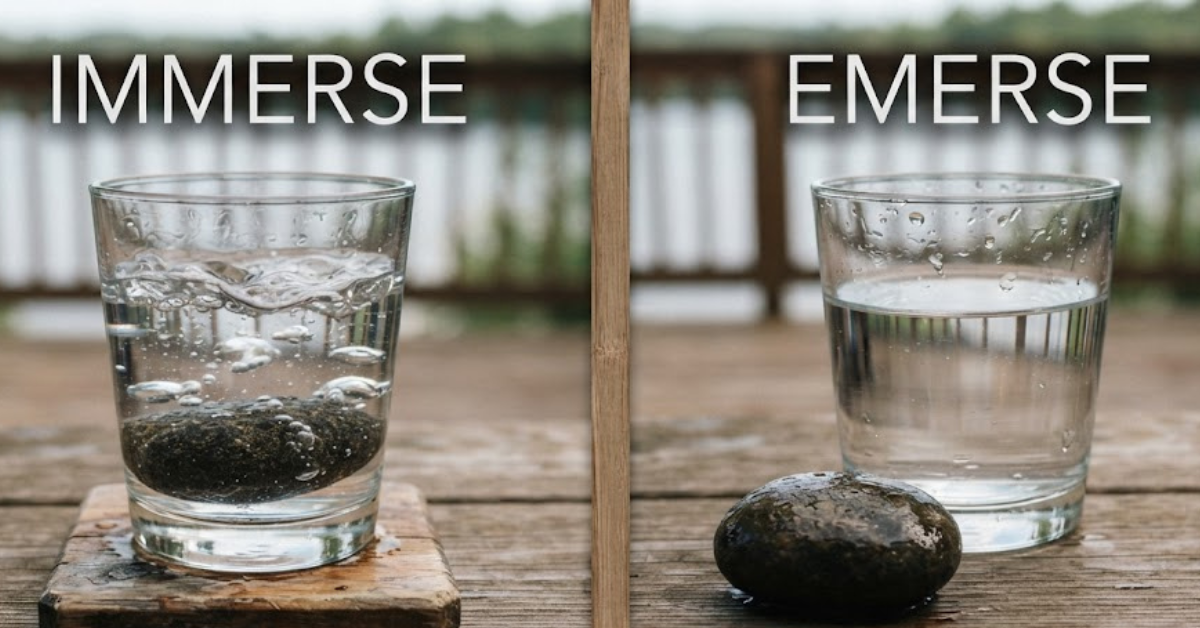
- Immerse means to put something into a liquid or to become deeply involved in something.
- Emerse means to rise out of a liquid or emerge from beneath the surface.
Although they sound similar, they describe opposite actions.
For example:
- The scientist immersed the sample in water.
- The aquatic plant became emersed as the water level dropped.
Think of it this way:
- Immerse = Go into
- Emerse = Come out of
What Does Immerse Mean?
The verb immerse means to place something completely into a liquid or to involve someone deeply in an activity, experience, or subject.
It has both literal and figurative meanings.
Literal Meaning
To completely submerge something in a liquid.
Examples:
- Immerse the vegetables in cold water.
- The photographer immersed the camera housing underwater.
- The fabric was immersed in dye.
Figurative Meaning
To become deeply involved or absorbed.
Examples:
- She immersed herself in learning Spanish.
- He immersed himself in the novel.
- Students should immerse themselves in the research.
This figurative use is extremely common in modern English.
What Does Emerse Mean?
The verb emerse is much less common.
It means:
To rise out of water or another liquid.
You’ll most often encounter it in:
- Biology
- Botany
- Ecology
- Marine science
- Aquatic research
Unlike “emerge,” which is widely used in everyday language, “emerse” is considered a technical term.
Example:
- The turtle emersed from the pond.
- The rocks emersed after the tide receded.
Emersed vs Immersed
Many people also search for emersed vs immersed because these are the adjective forms.
Immersed
“Immersed” means completely covered by liquid or deeply involved in something.
Examples:
- The phone was immersed in water.
- She became immersed in her studies.
- The divers remained immersed for several minutes.
This word is common in both everyday conversation and professional writing.
Emersed
“Emersed” describes something that has emerged from water or grows above the water’s surface.
It is especially common in botanical descriptions.
Example:
- The plant has emersed leaves.
- The stems remained emersed above the waterline.
This usage is far less common outside scientific fields.
Immerse or Emerse: Which Should You Use?
The answer depends entirely on what you’re describing.
Use immerse when talking about:
- Putting something into water
- Becoming deeply engaged
- Learning
- Reading
- Experiences
- Meditation
- Language study
Use emerse when talking about:
- Something rising from water
- Aquatic plants
- Marine animals
- Scientific observations
- Water levels
For most everyday writing, immerse is the correct choice.
Why “Immerse” Is More Common
There are several reasons why immerse appears much more frequently.
Everyday Applications
People regularly talk about:
- Immersing themselves in books
- Immersive learning
- Immersive experiences
- Immersive technology
- Immersive games
These expressions have become standard English.
Figurative Usage
Unlike emerse, immerse has many metaphorical meanings.
Examples:
- Immerse yourself in the culture.
- Immerse yourself in music.
- Immerse yourself in history.
This flexibility makes it far more useful in everyday conversation.
Scientific Use of “Emersed”
The adjective emersed appears most often in biology and botany.
For example, aquatic plants are commonly classified as:
Submerged Plants
Entirely underwater.
Examples:
- Eelgrass
- Hornwort
Floating Plants
Rest on the water surface.
Examples:
- Water lilies
- Duckweed
Emersed Plants
Roots remain underwater while leaves extend above the surface.
Examples:
- Cattails
- Reeds
- Rushes
This terminology helps scientists describe aquatic ecosystems accurately.
Common Examples
Here are some examples showing both words in context.
Immerse
- Immerse the painting brush before using it.
- She immersed herself in the documentary.
- The chef immersed the vegetables in ice water.
- They immersed themselves in local traditions while traveling.
Emerse
- The turtle emersed from the lake.
- The plants became emersed during the dry season.
- As the floodwaters receded, rocks emersed along the riverbank.
- Several aquatic stems remained emersed above the surface.
Common Mistakes
Because the words look alike, they’re often confused.
Mistake 1: Using Emerse Instead of Immerse
Incorrect:
I want to emerse myself in history.
Correct:
I want to immerse myself in history.
Mistake 2: Assuming Emerse Is a Misspelling
It’s not.
Although uncommon, emerse is a legitimate English word with a specialized meaning.
Mistake 3: Confusing “Emerse” with “Emerge”
Many people actually mean emerge, not emerse.
Compare:
- The whale emerged from the ocean.
- The whale emersed from the ocean. (technical)
- The whale immersed from the ocean.
In everyday English, emerge is almost always preferred over emerse.
Immerse, Emerse, and Emerge: Quick Comparison
| Word | Meaning | Common Usage |
| Immerse | Put into liquid or become deeply involved | Very common |
| Emerse | Rise from liquid | Rare, scientific |
| Emerge | Come out or become visible | Extremely common |
This explains why many English speakers have never encountered “emerse.”
Practical Tips for Remembering the Difference
These memory tricks can help:
Remember “Immerse”
Think:
In = Into
Immerse means going into something.
Remember “Emerse”
Think:
E = Exit
Emerse means coming out of something.
Use Context
Ask yourself:
- Is something going into water?
- Or coming out of water?
The answer tells you which word fits.
Key Takeaways
- Immerse means to place something into liquid or become deeply involved.
- Emerse means to rise out of water and is mainly used in scientific contexts.
- Immersed is common in both literal and figurative English.
- Emersed is mostly used in biology and botany.
- In everyday writing, “immerse” is far more common than “emerse.”
Frequently Asked Questions
What is the difference between immerse vs emerse?
Immerse means to put something into water or become deeply involved in an activity. Emerse means to rise out of water and is primarily used in scientific or technical writing.
Is emerse a real word?
Yes. Although it’s uncommon, “emerse” is a legitimate English word. It is mainly found in biology, botany, ecology, and marine science.
Which is correct: immersed or emersed?
Both are correct, but they describe different situations. “Immersed” refers to being submerged or deeply engaged, while “emersed” refers to emerging above the water’s surface.
Should I use immerse or emerse in everyday writing?
For most everyday situations, “immerse” is the correct choice. “Emerse” is rarely needed unless you’re discussing scientific topics involving aquatic organisms or plants.
Is emerse the same as emerge?
Not exactly. Both involve coming out of something, but “emerge” is the standard everyday word, while “emerse” is a specialized scientific term often referring specifically to rising from water.
Why is immerse more common than emerse?
Immerse has both literal and figurative meanings, making it useful in many situations. Emerse has a narrow technical meaning, so it appears mainly in scientific writing.
Conclusion
Understanding immerse vs emerse becomes much easier once you recognize that the two words describe opposite actions. Immerse means going into a liquid or becoming deeply engaged in an experience, while emerse refers to coming out of water and is primarily used in scientific contexts such as botany, ecology, and marine biology.
For everyday communication, you’ll almost always use immerse or immersed, whether you’re talking about learning a new language, reading a great book, or submerging an object in water. Reserve emerse and emersed for technical discussions involving aquatic environments. Knowing the distinction not only improves your vocabulary but also helps you write with greater precision and confidence.